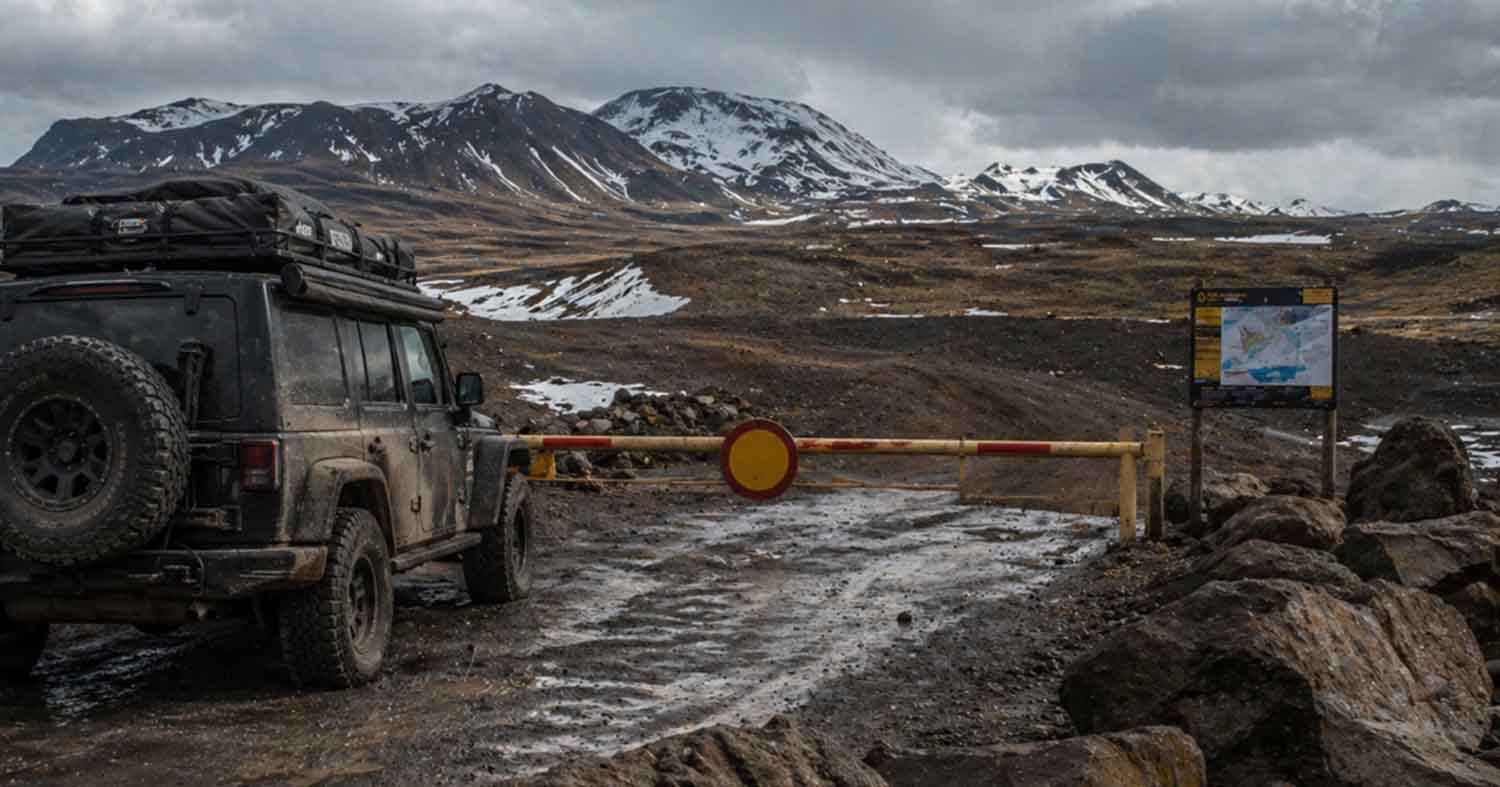
Last September, rangers at Landmannalaugar turned away a convoy of modified Toyota Land Cruisers from entering the F208 Fjallabaksleið syðri because their tire pressure exceeded the newly implemented 1.5 bar maximum. The German overlanders had driven 2,400 kilometers to reach Iceland’s highlands, only to discover that bureaucrats in Reykjavik had quietly rewritten the access rules while they were crossing the North Sea on the Smyril Line ferry.
The Highland Access Wars have begun, and Iceland’s legendary F-roads are ground zero for a conflict that will determine the future of overlanding freedom across Europe. The F208, F225, F35 Kjölur, and dozens of other highland routes that have defined Icelandic adventure driving for decades now face a patchwork of new restrictions, seasonal closures, and equipment mandates that change faster than the weather on Vatnajökull glacier.
The New Rules Nobody Talks About
The Icelandic Environment Agency implemented the Highland Access Framework in 2023, but most overlanders learn about it the hard way—at checkpoints. The framework divides Iceland’s 130 designated F-roads into three categories based on environmental sensitivity, with each tier carrying different vehicle requirements and seasonal restrictions.
Category 1 routes like the F35 Kjölur remain accessible to any 4×4 with adequate ground clearance, but Category 2 roads including the F208 Landmannalaugar route now require vehicles to maintain tire pressures between 1.2 and 1.5 bar to minimize ground disturbance. Category 3 routes, which include sections of the F910 through Askja caldera, are limited to vehicles weighing less than 3,500 kilograms fully loaded and require advance permits during peak season from June through August.
The Icelandic Association for Search and Rescue (ICE-SAR) supports many restrictions, citing 312 highland rescues in 2023 alone—a 40% increase from 2019. Their data shows that 68% of these incidents involved improperly equipped vehicles or drivers unfamiliar with river crossings and loose volcanic terrain.
Environmental groups led by Landvernd have pushed for even stricter measures. Their 2024 impact study documented tire tracks persisting for over five years in highland moss fields, and vegetation damage extending up to 50 meters from established tracks where drivers detoured around mud holes or stuck vehicles.
Tourism Gold Rush Versus Highland Ecology
The underlying tension runs deeper than tire pressure gauges and weight limits. Iceland’s highland tourism generated an estimated 2.8 billion ISK ($20.1 million USD) in 2023, according to the Icelandic Tourist Board, but this economic engine depends on the same fragile highland ecosystems that environmental groups seek to protect.
Tour operators running modified Mercedes Unimogs and Volvo C303s through routes like the F88 Öskjuvegur generate significant revenue for rural communities, but their heavy vehicles create deeper ruts and require more maintenance on highland tracks. Independent overlanders in personal vehicles contribute less direct economic impact but argue they follow Leave No Trace principles more consistently than commercial operators.
The conflict reached a flashpoint in July 2024 when Landvernd documented a commercial tour convoy creating a new track across pristine highland vegetation near Herðubreið mountain after the established F88 route became impassable due to flooding. The resulting social media controversy led to temporary closure of the entire F88 corridor while officials developed new crossing protocols.
Local communities in highland gateway towns like Selfoss and Hella find themselves caught between tourism revenue and environmental pressure. Municipal councils report that highland tourism supports approximately 1,200 jobs across the region, but they also face mounting cleanup costs for damaged highlands and increased search-and-rescue expenses.
What This Means for Your Next Highland Expedition
Practical implications for overlanders planning highland expeditions extend beyond bureaucratic compliance. The new framework requires advance route planning that most drivers haven’t needed before. The F735 road to Þórsmörk now requires online registration 48 hours in advance during peak season, and the system frequently shows “full” status by early May for July departures.
Vehicle preparation has become more complex. The tire pressure monitoring requirements mean carrying a reliable compressor and gauge—rangers at highland checkpoints use calibrated digital gauges and don’t accept “close enough” readings. Weight restrictions on Category 3 routes eliminate many fully-loaded expedition vehicles and require careful gear selection that prioritizes essential items over comfort equipment.
River crossing protocols have formalized significantly. The F26 Sprengisandur route now prohibits crossing at 14 designated points during high water periods, with official detour routes that add up to 60 kilometers to the journey. GPS waypoints for approved crossing locations are available through the Icelandic Road Administration app, but cellular coverage remains spotty throughout highland regions.
Enforcement varies widely but is increasing. Highland rangers now patrol previously unmonitored routes using GPS tracking to document off-track driving and issue fines ranging from 50,000 to 200,000 ISK ($360 to $1,440 USD) for environmental violations. Some overlanders report encountering ranger checkpoints on remote routes like the F910 that previously saw official presence only during emergencies.
The Bigger Picture: Europe’s Overlanding Future
Iceland’s highland restrictions represent the leading edge of a broader European trend toward limiting vehicle access in sensitive natural areas. Similar debates are emerging across Scotland’s North Coast 500, Romania’s Carpathian Mountains, and Norway’s Finnmark region as governments balance outdoor recreation with environmental protection and climate change concerns.
The overlanding community’s response will likely determine how these policies evolve. Responsible operators who embrace new requirements and demonstrate minimal environmental impact may preserve access to restricted areas, while those who ignore regulations risk triggering broader closures.
Iceland’s approach offers both warning and template for other European nations considering access restrictions. The highland framework acknowledges that complete vehicle bans are economically and politically unfeasible, but it establishes precedent for detailed regulation of recreational vehicle access in sensitive environments.
Q: Which Iceland F-roads currently require advance permits?
The F910 to Askja, F735 to Þórsmörk, and sections of the F208 Landmannalaugar route require advance registration during peak season from June through August through the Icelandic Road Administration online system.
Q: What tire pressure is required for Category 2 F-roads?
Category 2 F-roads including the F208 and F225 require tire pressures between 1.2 and 1.5 bar, verified by rangers using calibrated digital gauges at checkpoint locations.
Q: How much do environmental violation fines cost on Iceland’s F-roads?
Fines for off-track driving and environmental violations range from 50,000 to 200,000 ISK ($360 to $1,440 USD) depending on the severity and location of the violation.
Q: When do highland ranger patrols typically operate on F-roads?
Highland ranger patrols operate most frequently from June through September, with increased presence during peak tourism months of July and August on popular routes like the F35 Kjölur and F26 Sprengisandur.
Q: What vehicle weight limit applies to Category 3 F-roads?
Category 3 F-roads restrict vehicles to a maximum weight of 3,500 kilograms fully loaded, which eliminates many expedition-equipped vehicles and larger overlanding rigs from accessing these sensitive routes.
Q: How far in advance should I plan for Iceland highland routes?
Popular highland routes requiring permits often reach capacity by early May for July and August dates, so planning and registration should begin at least 10-12 weeks before your intended travel dates.
Have a dirty day.