
Contributor Guide For The Dirty Mule
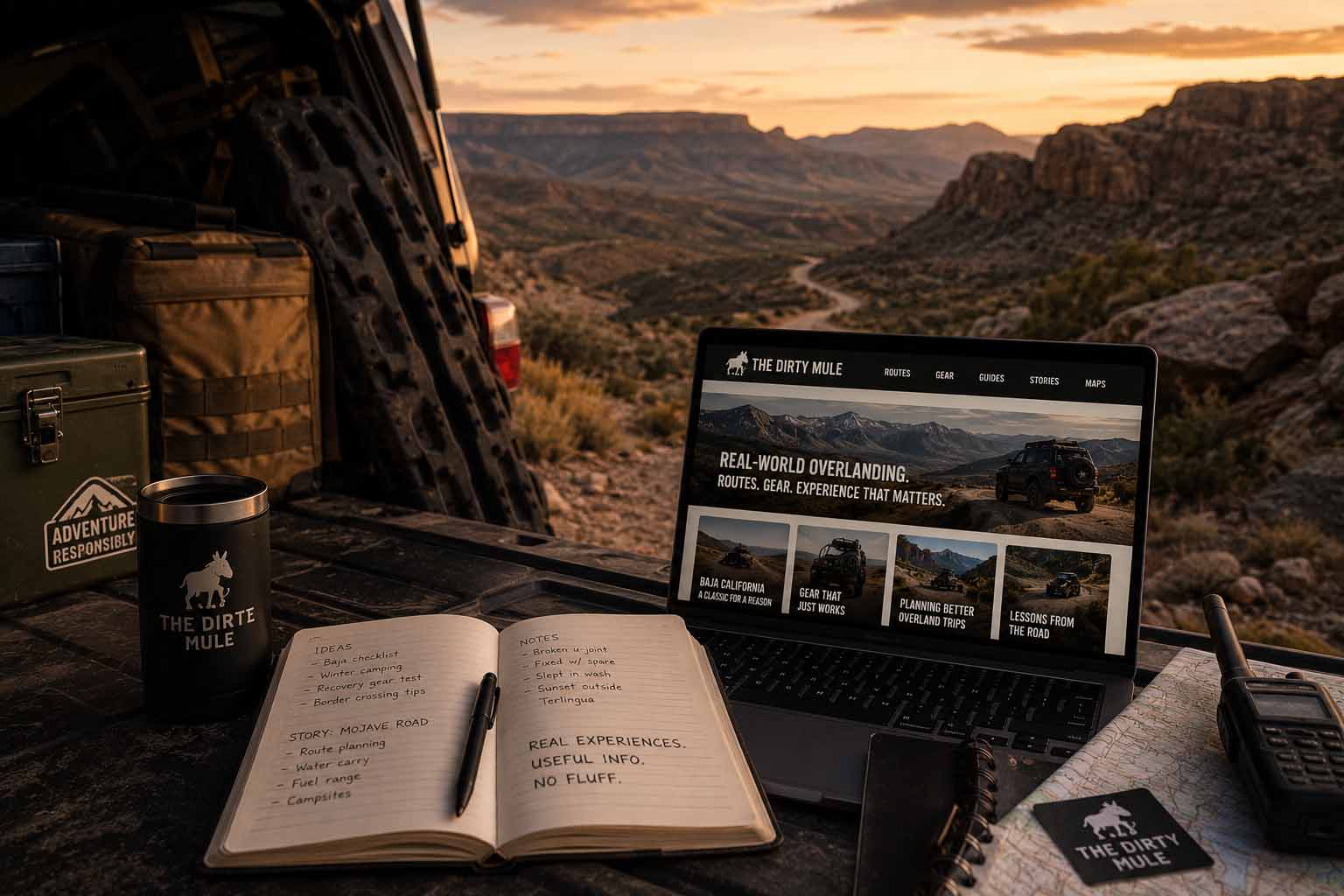
Write for The Dirty Mule
We’re building the overlanding publication we’d want to read. That requires writers who’ve been out there — who’ve broken down on a forest road, slept in a wash, talked their way across a border, fixed something with the wrong tool because that’s all that was in the kit. If that sounds like you, keep reading.
What we publish
Three main streams:
Trail entries. Documented overland routes with verified specs, real-world conditions, and the dirt that doesn’t make it into the official park brochure. Length, difficulty, surface, fuel intervals, water sources, the rig you ran, the spot where you almost broke a driveshaft. Every entry has to have ground-truth detail that came from actually driving it.
Gear reviews. Honest assessments of equipment used long enough to know how it actually performs. We don’t publish first impressions, marketing summaries, or content lifted from spec sheets. A real gear review covers what the manufacturer doesn’t tell you — the rattle that develops at 4,000 miles, the way the latch sticks in dust, the part that fails first.
Journal entries. Long-form trip reports, mechanical post-mortems, historical features, regional access debates, expedition narratives, and the occasional opinion piece. This is where the storytelling lives. Recent examples include investigations into Iceland’s highland access restrictions, a deep dive on Death Valley’s Titus Canyon closure, and a forensic look at Black Bear Pass fatalities.
What we don’t publish
A short list to save us both time:
- “Top 10 overlanding tips for beginners” or any other generic listicle that exists everywhere
- Vehicle comparison articles you could’ve written from a review aggregator
- Product roundups where you haven’t owned or tested the products
- Anything that reads like brand-sponsored content disguised as editorial
- Trail descriptions written without having actually driven the trail
- AI-generated content presented as personal experience
- Anything that ranks “best trails” without ranking criteria readers can verify
If your pitch falls into any of these, save us the email.
Who’s a good fit
We’re looking for contributors who:
- Have real experience with the subject. Driven the trail. Owned the gear. Lived the story.
- Can write. Not “write a blog post” can-write — we mean clean sentences, considered structure, and the discipline to revise.
- Care about facts. We verify what we publish. If you make things up or wing the specs, we’ll find out, and the byline ends there.
- Respect the land. If your pitch involves a closed trail, a contested area, or a workaround past a barrier, we’re not the right home for it.
- Have a perspective. We don’t want neutral reporting on overlanding. We want your take, your voice, your judgment about what matters.
We don’t require professional writing credentials. We don’t require huge social followings. We do require demonstrable knowledge, careful work, and a writing sample that shows you can deliver.
What we look for in a pitch
A good pitch is short — 200 to 400 words — and includes:
- The subject in one sentence. “I want to write about the Magruder Corridor.” Not “I’d love to discuss potential opportunities to collaborate on content.”
- Why this story, why you in two or three sentences. What’s the angle? Why are you the right person to write it?
- Why now if relevant. Closures, anniversaries, seasons, regulatory changes — anything that gives the piece urgency.
- A specific structure if you have one. “Roughly 1,800 words, opening with the 2019 Forest Service ruling, three sections on access fight, current status, and what’s next.”
- A writing sample. Published or unpublished. Doesn’t have to be overlanding-related, just has to be your work, and has to demonstrate you can write.
- Your background. Briefly. Who you are, what you drive, where you’ve been.
No need for cover-letter formality. We read fast. Get to the point.
The editorial process
What happens after you pitch:
- First response within two weeks. Either we’re interested and want to discuss, we have notes that would make it a fit, or we’re passing. We try not to ghost.
- If we move forward, you’ll get a brief. Word count target, structure notes, voice guidance, deadline. We work in markdown drafts.
- First draft is the writer’s responsibility. We’re not a content shop that writes from your outline — you’re the writer.
- Editorial pass. Usually one to two rounds of line edits, sometimes structural notes. We’re hands-on but we don’t rewrite your voice.
- Fact-check and verification. We confirm trail specs, dates, agency names, fatality counts, anything that has a verifiable answer. If we can’t verify something, it gets cut or hedged.
- Publish. With your byline, photo, bio, social links, and personal website at the bottom of the article.
Timeline from accepted pitch to published article is usually three to six weeks for journal pieces. Trail entries can move faster.
Compensation
We don’t pay yet. We will when the business supports it, and contributors who built early will be the ones we pay first.
What we offer in the meantime:
- A real audience. The Dirty Mule is growing. Your work goes in front of overlanders who are doing trips, buying gear, and looking for serious writing about the practice.
- A complete author profile. Every contributor gets a full author page on the site, with photo, bio, social links, and personal website. Every article you publish links to your profile.
- Editorial care. You’re not a content provider. You’re a writer with an editor who reads your work carefully and helps you make it better.
- A platform for your voice. Contributors keep their tone, perspective, and identity. We don’t ghost-rewrite to a house style — we sharpen what’s there.
If “no pay” is a deal-breaker, that’s a reasonable place to land. We’re not offended. We hope you reconsider when the business supports paid work.
Rights and ownership
You retain copyright on your work. We get exclusive first publication rights for 90 days, then non-exclusive perpetual rights to keep the article on the site. You can republish elsewhere after 90 days as long as you credit The Dirty Mule as the original publisher.
You own your photos. We use them in the article with credit. If we want to use them elsewhere on the site (banners, social, marketing) we’ll ask first.
AI policy
This is 2026 and AI writing tools are everywhere. Our position:
- AI as research assistant: fine. Use Claude, ChatGPT, Perplexity to gather sources, draft outlines, generate first-pass drafts you’ll then rewrite. We do this ourselves.
- AI as fact source: not fine. Don’t trust AI-generated facts. Verify every name, date, mileage, and claim against an authoritative source.
- AI as ghostwriter: not fine. If the article is substantially AI-written without meaningful human authorship, that’s not your voice — that’s a chatbot. We can tell, and so can readers.
- Disclosure: required when significant. If AI contributed materially to the piece (more than research and minor editing), disclose at the bottom: “This article was developed with the help of AI for research and drafting. Final writing, fact-checking, and editorial decisions are the author’s.” Be honest about it. We disclose when we use AI; we expect contributors to do the same.
How to pitch
Email hello@thedirtymule.com with the subject line “Pitch: [your topic]” — e.g., “Pitch: The Magruder Corridor at dusk.”
Include the pitch (200-400 words), your writing sample (link or attached PDF), and your social handles. Don’t attach giant photo files for the pitch stage — wait until we ask.
We try to respond within two weeks. If you haven’t heard back in three weeks, it’s fine to nudge once.
A few examples of what good looks like
Recent published work that hits the mark:
- Highland Access Wars: The Battle Over Iceland’s F-Roads — original reporting on a regulatory shift, structured around concrete data and quotes from named agencies
- Death Valley’s Forgotten Killer: The Real Story Behind Titus Canyon’s Closure — historical investigation grounded in declassified documents and survivor interviews
- The Jeep That Didn’t Make It: What Really Happens When Black Bear Pass Goes Wrong — forensic look at named incidents, with rescue report sourcing and equipment analysis
What these have in common: a clear angle, specific named subjects, verifiable facts, and a perspective that takes a position rather than hedging.
If your pitch can do that, we want to read it.
Email hello@thedirtymule.com. Pitches only — general overlanding questions go to the same address but with a different subject line.
Have a dirty day.